

Tuber davidlopezii Ant. Rodr. & Morte
Persoonia 48: 365 (2022)
Etymology:
Named after David López Carreño, a renowned Spanish chef specializing in mycology, in recognition of his valuable contribution to the dissemination of truffles in gastronomy.
Macroscopic characters:
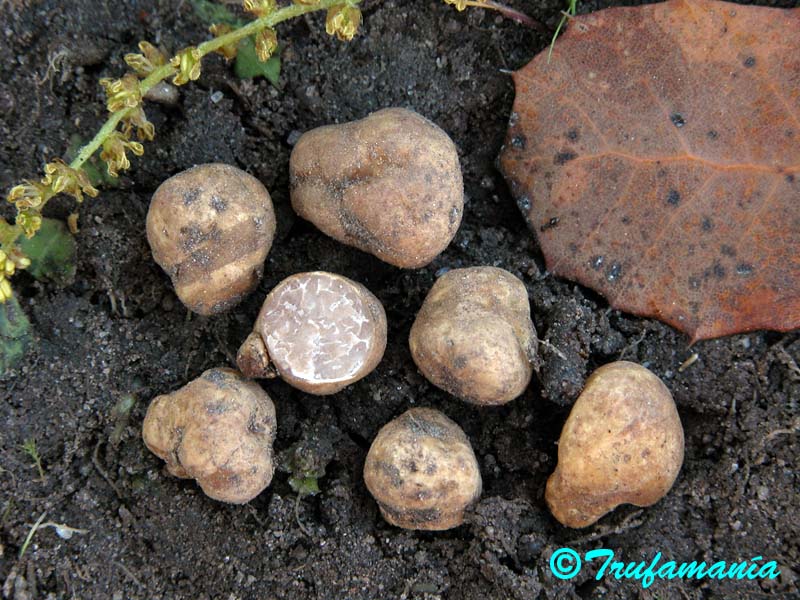
Ascomata: hypogeous, 0.5–1 cm in diam., subglobose to irregular and gibbous, solid, firm, whitish at first, becoming pale brown at maturity, smooth.
Gleba: whitish when immature, becoming dark brown at maturity, marbled with thin white veins.
Odour: slight, not distinctive.
Taste: faint, nutty.
Habitat:
Tuber davidlopezii grows in acidic soils in Spanish dehesas, where it forms mycorrhizae with Quercus ilex subsp. ballota in spring. It is currently known only from Cáceres and Seville, Spain.
Notes:
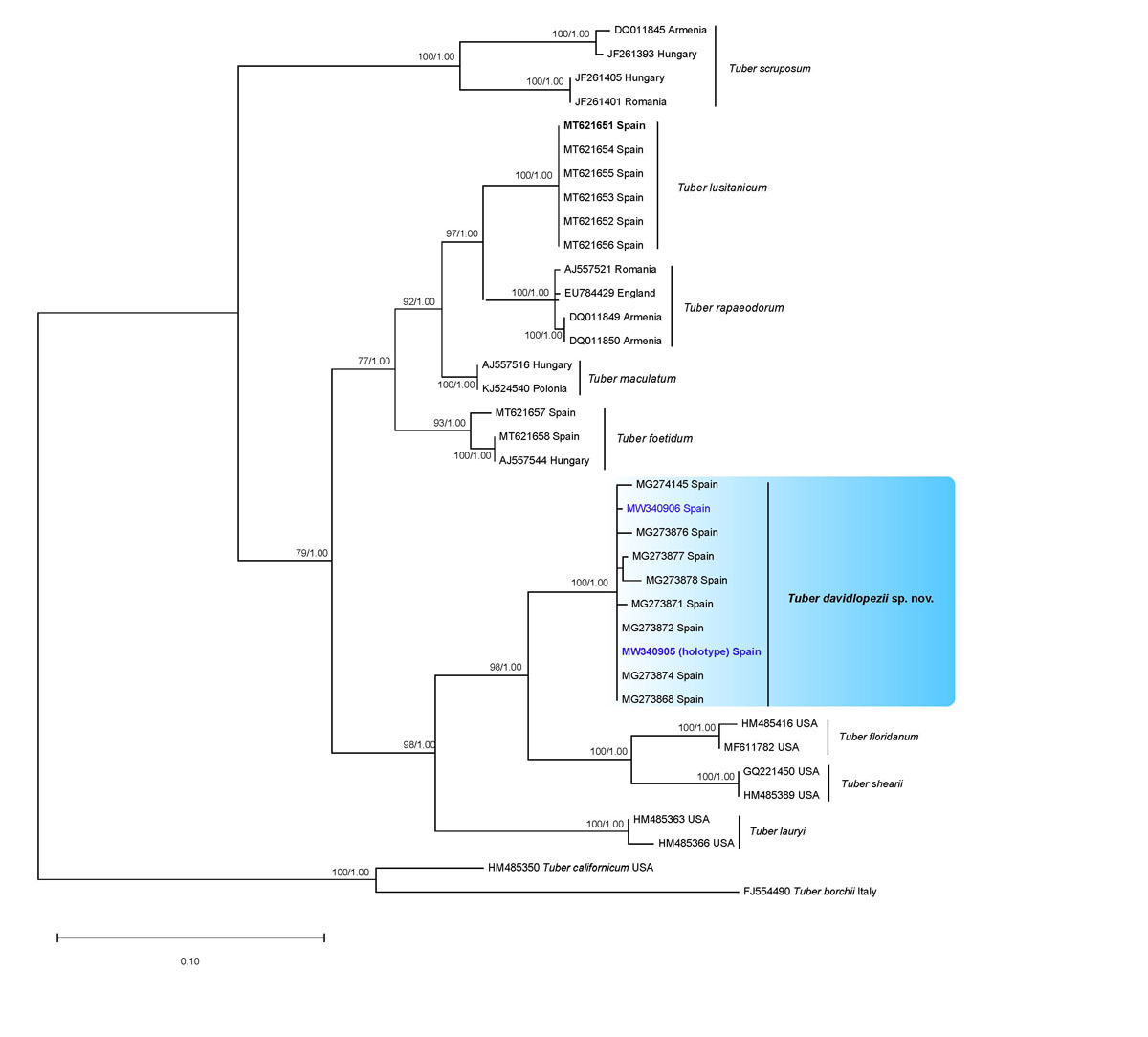
Recent DNA-based phylogenetic studies on Tuber have shown that the genus is more diverse than previously suspected (Eberhart et al. 2020), and includes many still undescribed taxa. Among these, T. davidlopezii is a whitish truffle that clusters within the maculatum clade, and is characterised by its smooth cream-white peridium, brown gleba marbled with thin white veins, and globose, reticulate-alveolate spores. Tuber davidlopezii differs from all other species of the maculatum clade by its globose spores and molecular data. Tuber rapaedorum has larger, ellipsoid spores (Ceruti et al. 2003). Tuber maculatum has a prosenchymatous peridium and ellipsoid spores (Mello et al. 2000).
Microscopic characters:
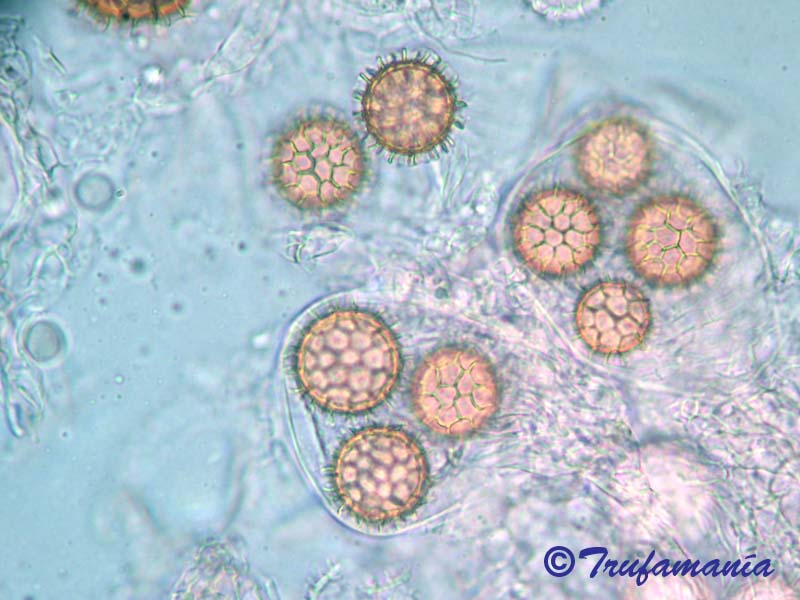
Asci: inamyloid, 70–100 × 50–80 μm, with walls up to 2.5 μm thick, ellipsoid to subglobose, sessile or shortly stipitate, 1–4(–5)-spored.
Ascospores: globose to subglobose, 24–42 × 23–40 μm (av. Q = 1.02), excluding ornamentation; walls 2–4 μm thick, initially hyaline, becoming yellowish brown at maturity; reticulum with 4–6(–8) alveolar meshes along the spore length, polygonal, 5–6-sided, with alveolar walls up to 6 μm high.
Peridium: 200–300 μm thick, two-layered; outer layer pseudoparenchymatous, 50–100 μm thick, composed of subglobose to subangular cells, 5–25 μm diam., hyaline to yellowish, thick-walled; inner layer 100–200 μm thick, composed of hyaline, thin-walled, interwoven hyphae up to 8 μm broad at the septa, gradually intermixing with the gleba.
Phylogenetic analysis:
Phylogenetic tree. Maximum likelihood phylogeny based on ITS nuclear rDNA sequences showing the placement of Tuber davidlopezii among other taxa in the maculatum clade. Type specimens are indicated in bold. Newly generated sequences are in blue. The new species is marked with a blue square. Support values on branches indicate Maximum likelihood (ML) bootstrap values (BS) ≥ 70 % and Bayesian posterior probability values (PP) > 95 % (BS/PP). Tuber californicum and T. borchii were used as the outgroup. The scale bar indicates the expected number of changes per site. The ML analysis was performed in IQ-TREE v. 1.6.12 (Nguyen et al. 2015), using non-parametric bootstrap analysis (1 000 replicates) and the best-fit model (TN+F+G4), according to BIC, as determined with ModelFinder (Kalyaanamoorthy et al. 2017). Bayesian inference (PP) was performed in MrBayes v. 3.2.6 (1 million generations), allowing the software to estimate the evolutionary model (Ronquist et al. 2012). All other settings were left as default. Both ML and Bayesian analyses resulted in identical overall topology and therefore only the ML tree is shown.
 |
Antonio Rodríguez trufamania@gmail.com antonio@trufamania.com ORCID iD: 0000-0002-0708-7773 |